








Artiflix
定額で見放題

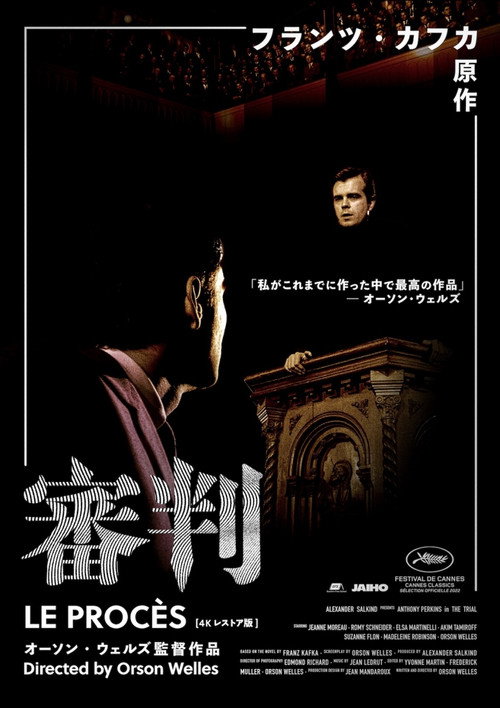
Le Procès
この作品の日本語あらすじはまだ登録されていません。
WHERE TO WATCH
※ 配信状況や料金は変更される場合があります。リンク先で最新情報をご確認ください。
YOUR REACTION
ゾクログユーザーのリアクション
OFFICIAL TRAILER
動画提供: YouTube / Official Trailer
作品情報を準備中です。
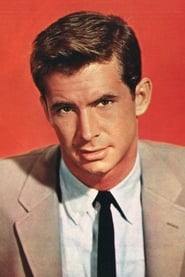 プロフィールを見る →
 プロフィールを見る →
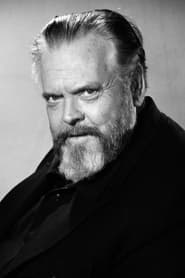 プロフィールを見る →
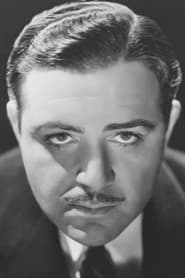 プロフィールを見る →
 プロフィールを見る →
AUDIENCE REVIEWS
There is something really quite terrifying about the scenario in which "Josef K" (a career-best performance from Anthony Perkins, I think) finds himself in this rather sinister thriller. He is awakened one morning to find the police in his bedroom. He is arrested and told he is to stand trial. For what, you might think? Well, that's what he wonders too - and every effort he makes to establish just what he is supposed to have done fails to deliver. His detention is hardly traditional either. He is largely free to come and go as he pleases, provided always that he is available to attend his questioning sessions by those who seem rather arbitrarily charged with deciding his guilt or innocence. As his (and our) frustrations grow, he explores the lives of those close to him - might the source of his predicament lie there? Luckily, his uncle learns of his situation and engages the learned advocate "Hastler" (Orson Welles) - but is he likely to prove an help or an hindrance? This story is Kafka as his very best. Machiavellian scheming mixed with the ultimate in "Big Brother" state manipulation; the disabling lack of information and the increasing exasperation of young "Josef" are successfully transferred onto an audience that shares his fears and apprehensions. Gradually, we learn a great deal about this man, his flaws, foibles and fetishes, but still are uncertain as to just what he is supposed to have done! A considerable degree of the menace here emanates from the dark photography and from an effective supporting cast who excel in perpetuating the mystery, too. Welles directs this with considerable aplomb, Jean Ledrut provides an evocative and mysterious score to accompany a screenplay that delivers the sense of vexation and chagrin well and compellingly. Fans of horror films ought to watch this too - it's one of the scariest films I have ever seen.
.
The Trial: Welles's Brilliant Exposition of Guiltless Guilt
Orson Welles's "The Trial" exists in a lineage of dystopian narratives that includes Kafka's original text of the same name, George Orwell's "1984", and Terry Gilliam's "Brazil" film - all works that explore bureaucratic dehumanization and the absurdity of institutional power.
If the first layer of the film reveals bureaucratic absurdity and inaccessible justice, its deeper strata explore a more insidious human condition: the phenomenon of "guiltless guilt" - an existential state where individuals internalize blame for circumstances beyond their control.
Josef K (Anthony Hopkins) isn't just a victim of an incomprehensible system; he's a subconscious participant in his own psychological prosecution. Welles suggests that guilt isn't an external judgment, but an internal landscape where humans reflexively blame themselves for random misfortunes.
This psychological mechanism echoes broader historical traumas. Like Kafka's prescient writing before the rise of Nazism, Welles exposes how undefined, internalized guilt enables systemic oppression. The nameless accusation becomes a mirror: "Perhaps I deserve this," people whisper to themselves, thus facilitating their own marginalization.
Religious narratives - from Eve's original sin to cultural mythologies of personal culpability - have long programmed this psychological response. We carry lucky charms, we apologize for being victims, we internalize blame as a perverse form of control.
In both "The Trial" and "Brazil", the visual language becomes a physical manifestation of this psychological oppression. Welles's stark, expressionist landscapes and Gilliam's grotesque, mechanical environments aren't mere backdrops, but external representations of internal psychological states. The labyrinthine bureaucracies become metaphors for the human mind's capacity for self-persecution, where architectural complexity mirrors psychological entrapment.
Welles and Gilliam share a crucial insight: systemic oppression isn't imposed from outside, but cultivated from within. Josef K and Sam Lowry aren't just victims; they're unwitting architects of their own psychological prisons. The surreal, nightmarish visual styles become a perfect translation of this internal landscape of "guiltless guilt" - where the most effective chains are the ones we forge for ourselves.
"The Trial" is less a film about justice than a profound exploration of how humans psychologically prepare themselves for, and participate in, their own oppression.
口コミはTMDBユーザーによる投稿です。ゾクログの見解を示すものではありません。
RECOMMENDED FOR YOU
RECENTLY VIEWED

みんなの一言
まだコメントはありません。最初の一言を投稿しませんか?